 CN
CN
 EN
EN


Wuhan Iron and Steel
Customer Introduction
Wuhan Iron and Steel Group Co., Ltd. is a super large steel joint venture built after the founding of the People's Republic of China. It began construction in 1955 and is an important state-owned backbone enterprise directly managed by the State owned Assets Supervision and Administration Commission. The main factory is located in the eastern suburbs of Wuhan City, Hubei Province, on the south bank of the Yangtze River, covering an area of 21.17 square kilometers. Wuhan Iron and Steel Group has a complete set of advanced steel production process equipment, including mining, coking, ironmaking, steelmaking, steel rolling and logistics, and supporting public and auxiliary facilities. After the joint restructuring of Hubei Iron and Steel, Liuzhou Iron and Steel, and Kunming Iron and Steel, it has become a large enterprise group with a production scale of nearly 40 million tons.
Facing challenges
Traditional hardware is aging, and security risks are prominent: The servers in core production scenarios have a long service life, which not only poses a risk of system downtime, but also threatens the security of industrial production core data.
business lacks high availability guarantee and continuity concerns: production business relies on traditional IT architecture and has not established a complete redundant disaster recovery mechanism. Once encountering sudden situations such as server failures and network interruptions, it is difficult to quickly restore business and can easily lead to production line shutdowns.
The operation and maintenance management is scattered and inefficient: The hardware devices (servers, terminals, storage) and software systems (various business systems, operation and maintenance tools) are managed in a decentralized manner, lacking a unified monitoring platform, and fault location takes a long time, resulting in low response efficiency.
Weak software and hardware bundling+external device control : Existing production systems heavily rely on low-level operating systems such as Windows XP, which has compatibility limitations with new hardware; At the same time, there is a lack of effective control over the access of external devices such as USB drives, and the information security defense line is not strong.
Solution
Juchen Technology aims to address the core pain points of Wuhan Iron and Steel by creating an intelligent solution with "industrial cloud desktop+distributed seat system" as the core. By using hyper converged architecture to achieve full virtualization of IT resources, integrating dispersed hardware to form a unified resource pool, and performing redundant processing on data and virtual machines, it not only solves the risk of traditional server aging failures, but also provides underlying disaster recovery support for production business, ensuring business continuity in the event of node or virtual machine anomalies.
Industrial cloud desktop further strengthens security and compatibility: strictly controls external USB drives and other devices to prevent data leakage and virus intrusion; At the same time, it breaks the limitations of software and hardware bundling, fully compatible with existing low version systems such as Windows XP at Wuhan Iron and Steel, and provides greater protection for existing IT investments, avoiding unnecessary system replacement costs.
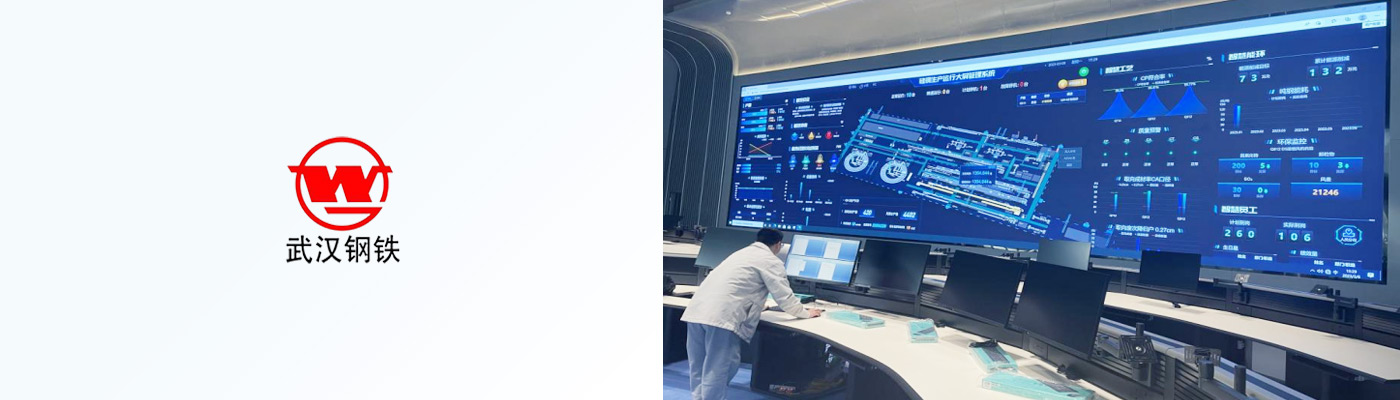
The centralized control seat system promotes the migration of the operation room to the centralized control center, achieving remote centralized production control, which not only improves operation and maintenance efficiency, but also keeps operators away from production line safety risks.
Customer Revenue
Redundancy Disaster Recovery+Business Continuity: Super Fusion Technology achieves dual redundancy of data and virtual machines. In the event of a single node failure or virtual machine failure, the system can quickly initiate business migration and data reconstruction mechanisms, completing fault recovery without manual intervention, ensuring the safety and efficiency of steel production.
Remote centralized control+security protection: achieves remote centralized operation through the centralized control agent system, and combines external device control with underlying security protection to effectively prevent data leakage, illegal access, and other issues, safeguarding the security of core production data.
Unified operation and maintenance+business integration: Full stack resources are included in the unified management and maintenance scope, and operation and maintenance personnel can complete real-time monitoring, fault handling and other operations through the desktop cloud platform, improving operation and maintenance efficiency; Unbinding software and hardware reduces system upgrade costs.
Relevant cases
View more+